Everything You Need to Know About Commercial Insulation
Melissa Grant
August 15th, 2026
If you own or manage a commercial building, insulation is probably not the first thing on your mind when you walk through the doors each morning. But it should be. The walls, roof, and foundation of your building are constantly working for you or against you, and insulation is the material that tips the balance in your favor. Every month that passes with an under-insulated building is money leaving through the walls, roof, and foundation in the form of wasted energy. Best Commercial Insulation for Different Buildings helps identify the right insulation approach to reduce these losses and improve building efficiency.
Commercial insulation is the broad category of thermal and acoustic materials installed in non-residential buildings, from office towers and warehouses to schools, retail spaces, and industrial facilities. It serves as the primary defense against energy waste, regulates indoor temperatures, controls moisture, reduces sound transmission, and helps meet increasingly strict building codes. The stakes are high. According to the U.S. Environmental Protection Agency (EPA), direct and indirect greenhouse gas emissions from homes and businesses accounted for 31% of total U.S. greenhouse gas emissions in 2022. Much of that is tied to how well our buildings are insulated and sealed.
This guide is the product of years of hands-on experience working with commercial buildings of every size and type. We have insulated everything from small retail strip malls to large industrial facilities, and we have seen firsthand what proper insulation can do for energy bills, occupant comfort, and building longevity.
The Science: How Commercial Insulation Works
Before we get into specific materials, you need to understand what insulation actually does. Insulation is not magic. It is applied physics. It slows down the transfer of heat between the inside of your building and the outside environment. Heat moves in three ways: conduction (direct transfer through solid materials), convection (movement through air currents), and radiation (transfer through electromagnetic waves). Commercial insulation addresses all three, but its primary job is to resist conductive heat flow.
Every insulation material is rated by its R-value, which measures thermal resistance, or how effectively the material resists heat transfer. The higher the R-value, the better the insulating power. All types of insulation perform equally well when properly installed and air sealed. That means there is no single “best” insulation material. The right choice depends on your building type, climate zone, budget, and performance priorities.
Expert Tip: Do not chase the highest R-value per inch at the expense of proper installation. An insulation material with a slightly lower R-value that is installed perfectly will outperform a higher-rated material that is compressed, gapped, or poorly fitted.
Air Sealing and Insulation Work Together
This point cannot be overstated: insulation without air sealing is a waste of money. Air carries both heat and moisture. If warm indoor air can flow through gaps and cracks around your insulation, the insulation loses its effectiveness because moving air strips away the trapped still air that does the actual insulating. In a typical building, air leakage accounts for a significant portion of energy loss. Sealing those leaks first, then adding insulation, is the correct sequence.
The Building Envelope Concept
Commercial insulation is part of your building’s envelope, the continuous system of walls, roof, foundation, windows, and doors that separates the conditioned interior from the unconditioned exterior. The insulation in your envelope works alongside air barriers, vapor retarders, and weather-resistant barriers to keep your building dry, comfortable, and energy-efficient. A weakness in any part of the envelope undermines the performance of the whole system.
Types of Commercial Insulation: A Detailed Comparison
Choosing the right insulation for a commercial project means understanding the strengths and limitations of each material. The following sections cover the major insulation types used in commercial construction.
Spray Foam Insulation
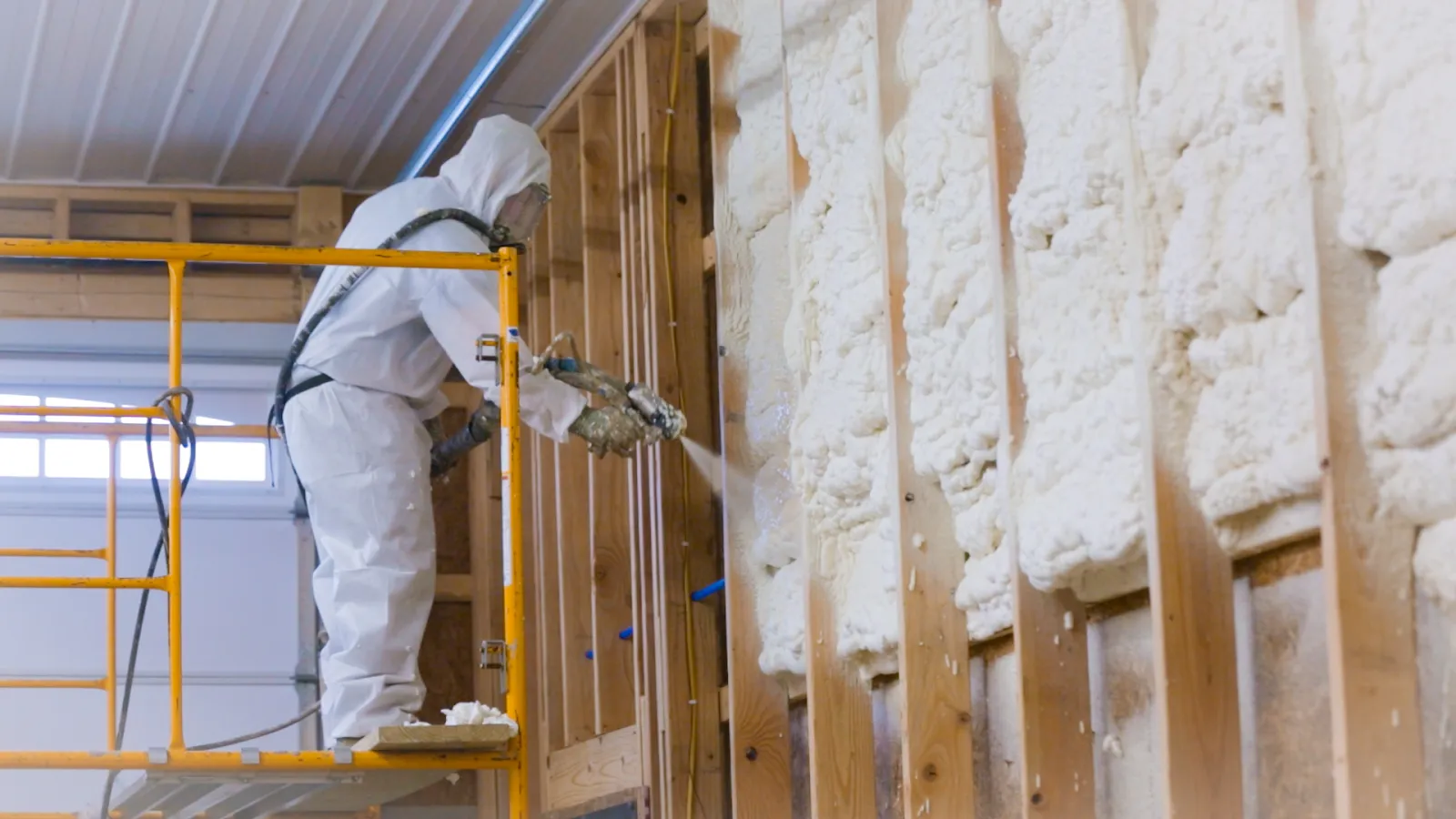
Spray foam insulation is applied as a liquid that expands to fill cavities and gaps, then hardens in place. It comes in two main varieties:
Open-cell spray foam has a lower density, expands significantly to fill spaces, and provides an R-value of roughly 3.5 to 3.8 per inch. It is an effective air barrier but not a vapor retarder.
Closed-cell spray foam is denser, offers an R-value of approximately 7 to 9 per inch, and serves as both an air barrier and a vapor retarder. It also adds structural rigidity to wall assemblies.
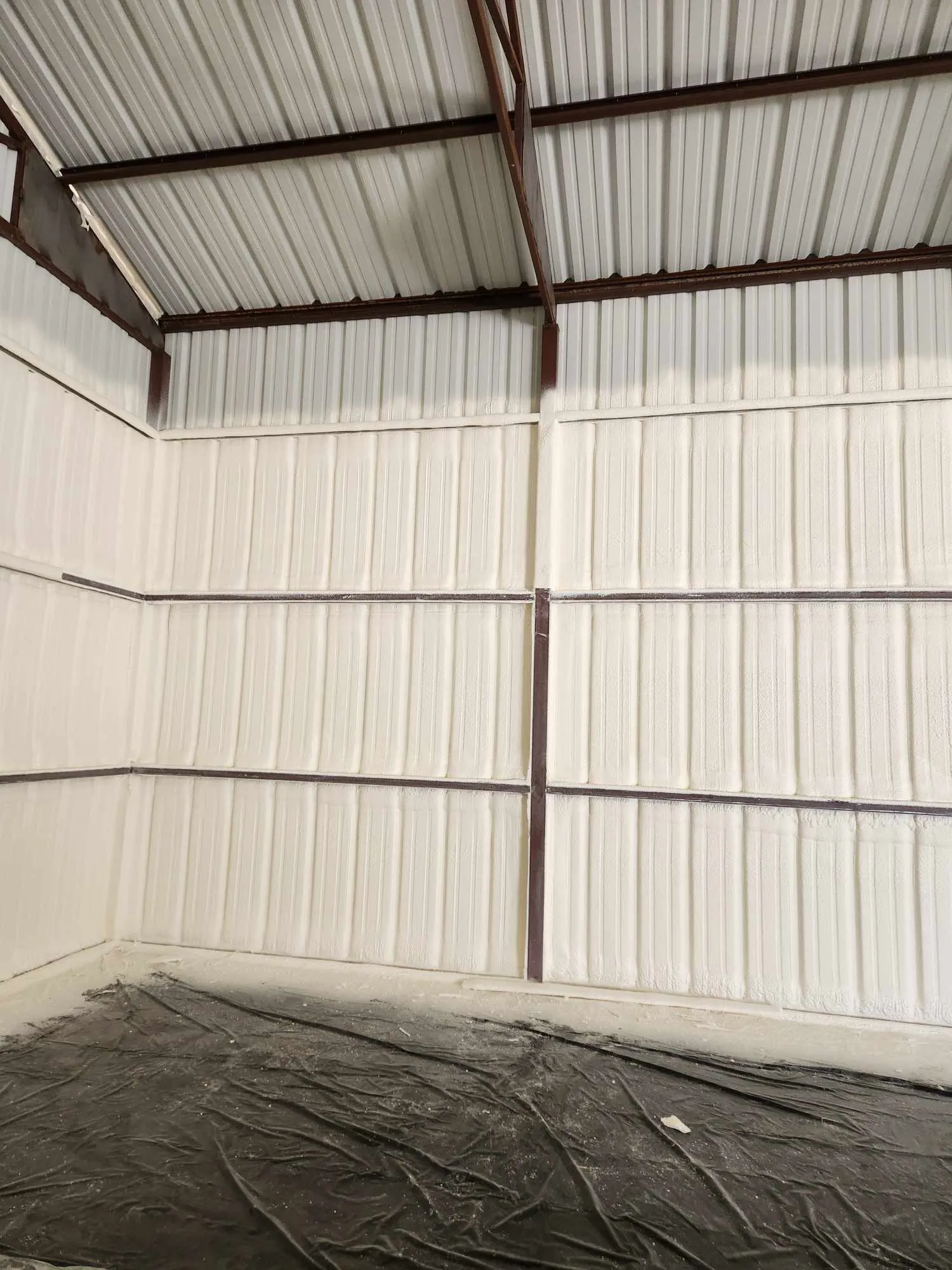
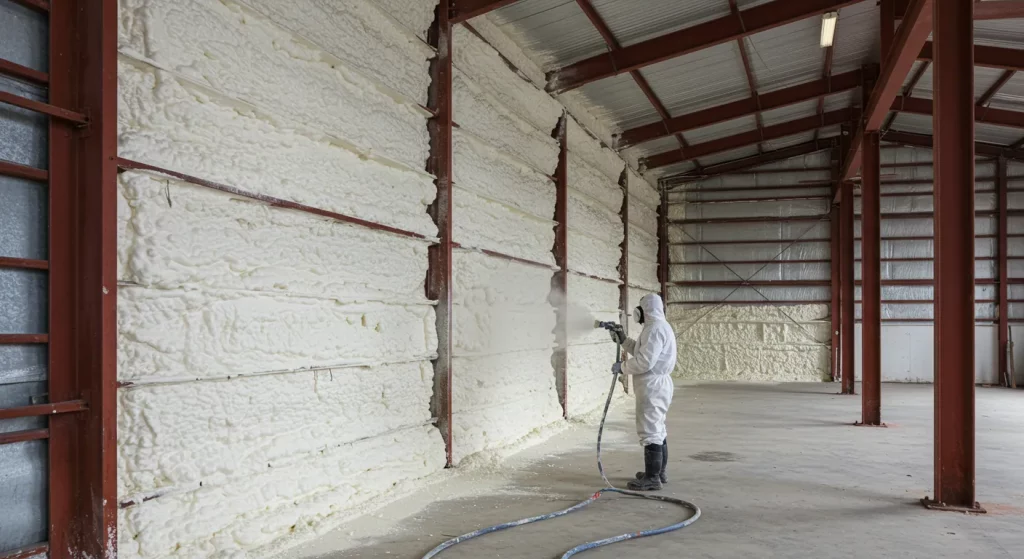
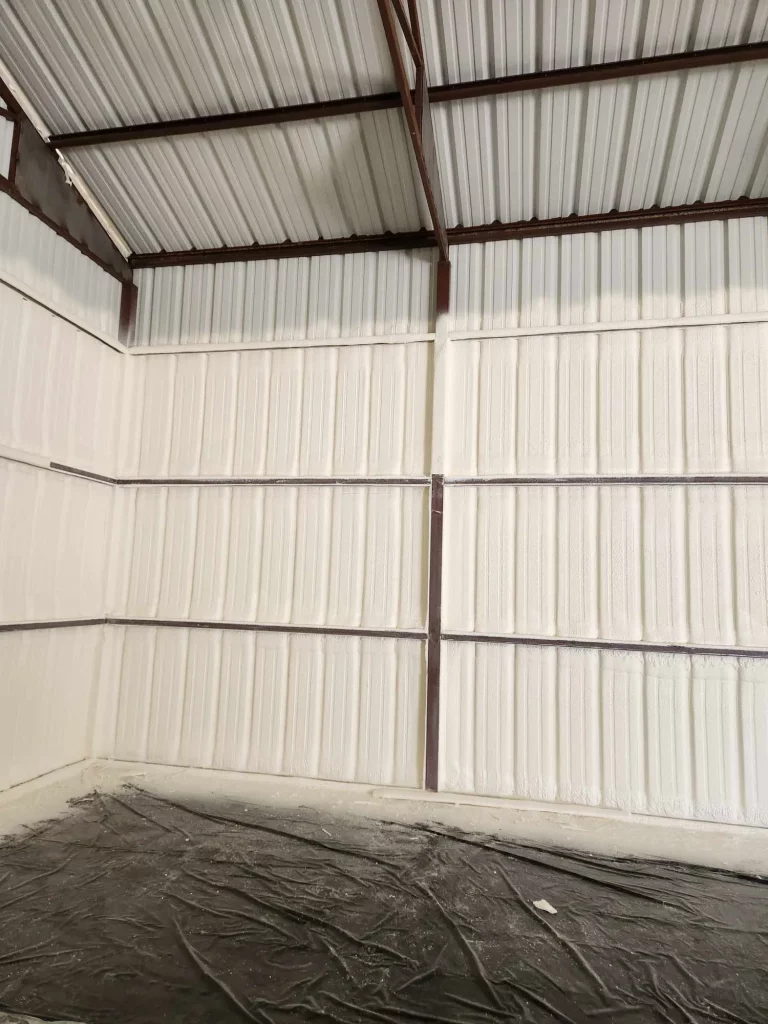
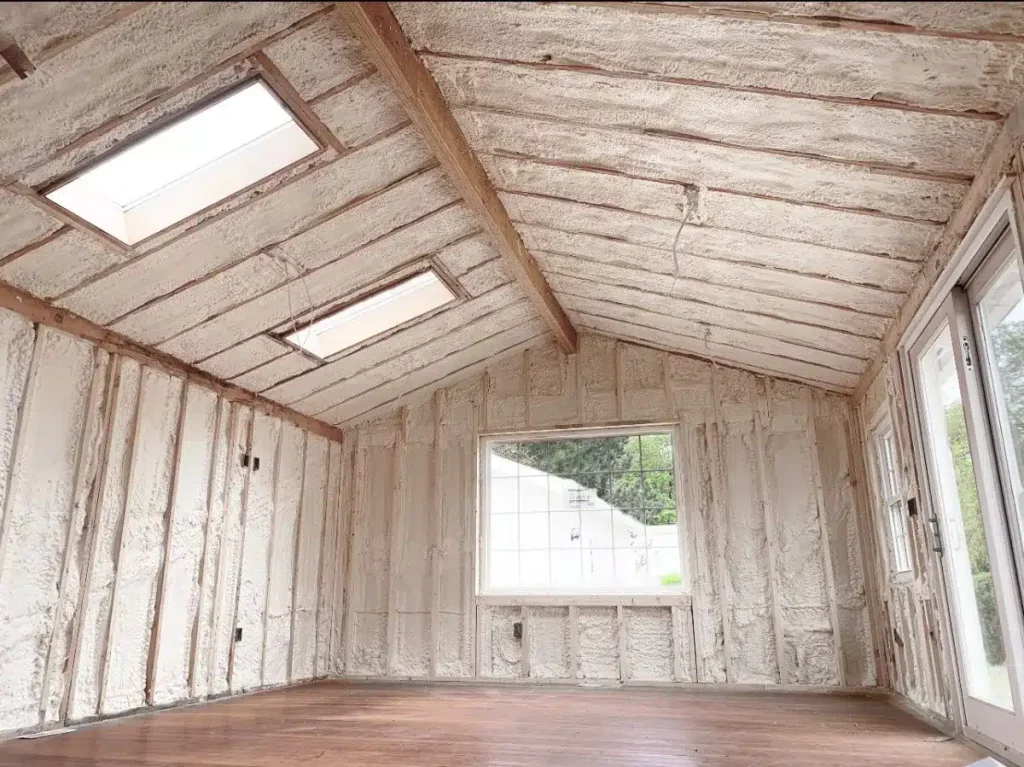
Spray foam excels at filling irregular spaces, sealing around penetrations, and providing an air barrier in a single application. It is widely used in commercial wall cavities, roof assemblies, and retrofit projects where access is limited.
Fiberglass Insulation
Fiberglass is the most widely used insulation material in commercial construction. It comes in batts, blankets, and loose-fill forms, with R-values typically ranging from 2.9 to 4.3 per inch depending on density. Fiberglass is naturally non-combustible, UV stable, and absorbs less than 1% of its weight in moisture, making it resistant to mold growth. It contains 40 to 60% recycled content and is reusable at the end of a building’s life.
Fiberglass batts do not settle over time, so thermal performance is maintained throughout the life of the building. When paired with standard air sealing practices, fiberglass and mineral wool insulation reduce air infiltration to near zero, according to independent testing by the National Association of Home Builders Research Center.
Mineral Wool Insulation
Mineral wool is made from stone or slag fibers spun into insulation. It achieves R-values of approximately 3.7 per inch in both batt and loose-fill forms. Its standout properties are fire resistance and sound absorption. Mineral wool can withstand extremely high temperatures without melting, making it the go-to choice for fire-rated walls, mechanical rooms, and steel stud assemblies in commercial buildings. It is naturally non-combustible and absorbs less than 1% moisture by weight.
Mineral wool also delivers excellent acoustic performance. It achieves a Sound Transmission Class (STC) rating of 43 as part of a standard exterior wall assembly, compared to 37 to 39 for spray foam in similar configurations.
Rigid Foam Board Insulation
Rigid foam boards come in three main types, each with distinct properties:
Polyisocyanurate (polyiso) offers the highest R-value per inch (5.6 to 8.7 depending on facing), making it valuable when space is limited. It is commonly used in commercial roof assemblies and exterior continuous insulation.
Extruded polystyrene (XPS) provides an R-value of about 5.0 per inch with excellent moisture resistance, making it suitable for below-grade and foundation applications.
Expanded polystyrene (EPS) is the least expensive rigid foam at R-3 to R-4 per inch and is the most vapor-permeable, allowing assemblies to dry more easily.
Rigid foam boards are especially effective as continuous insulation on the exterior of walls, where they cover framing members and reduce thermal bridging, the heat loss that occurs through wood or steel studs.
Cellulose Insulation
Cellulose is made from recycled newsprint treated with fire retardants. It has an R-value of approximately 2.9 to 3.8 per inch depending on the installation method. It is inexpensive and conforms well to irregular spaces, making it useful for retrofit wall insulation in existing commercial buildings. However, cellulose absorbs 5 to 20% of its weight in moisture, and because it is organic, it can serve as a food source for mold if moisture problems exist.
Comparison Table: Insulation Materials for Commercial Applications
Material
R-Value per Inch
Fire Resistance
Moisture Resistance
Sound Control
Best Commercial Applications
Closed-Cell Spray Foam
7 to 9
Ignites at 700°F
Excellent
NRC ~0.75
Roof assemblies, walls, air sealing
Open-Cell Spray Foam
3.5 to 3.8
Ignites at 700°F
Low
NRC ~0.75
Wall cavities, sound control
Fiberglass (Batts)
2.9 to 4.3
Non-combustible
Absorbs less than 1%
STC 43 / NRC up to 1.00
Walls, ceilings, HVAC systems
Mineral Wool
~3.7
Non-combustible
Absorbs less than 1%
STC 43 / NRC up to 1.00
Fire-rated walls, acoustic partitions
Polyiso Board
5.6 to 8.7
Requires thermal barrier
Moderate
Low
Roof insulation, exterior walls
XPS Board
~5.0
Requires thermal barrier
Excellent
Low
Below-grade, foundations, slabs
EPS Board
3 to 4
Requires thermal barrier
Good
Low
Exterior insulation, geofoam fill
Cellulose
2.9 to 3.8
Requires fire retardants
Absorbs 5 to 20%
Moderate
Retrofit wall cavities
Data sourced from Insulation Institute and U.S. Department of Energy Building America research.
Key Takeaways: Insulation Material Selection
No single insulation type is universally “best.” Match the material to the application, climate, and building type.
Fire resistance and code compliance requirements may narrow your choices significantly, especially in commercial occupancies.
The installed R-value matters more than the rated R-value per inch. Proper installation eliminates gaps, compression, and voids.
Where to Insulate in a Commercial Building
A commercial building has multiple insulation zones, and each one plays a different role in overall performance. Understanding where insulation matters most helps you prioritize projects and budget effectively.
Walls
Commercial walls account for a large portion of the building envelope surface area. Insulation in walls reduces conductive heat transfer and, when paired with proper air sealing, prevents air infiltration. In commercial construction, wall insulation typically goes into stud cavities (batts, blown-in, or spray foam) or is applied as continuous insulation on the exterior (rigid foam boards). Steel-framed commercial walls present a particular challenge because steel conducts heat much more readily than wood. Continuous exterior insulation is often the most effective solution for steel-stud buildings because it wraps the entire wall assembly and interrupts thermal bridging at every stud location. [Detailed Guide on Commercial Wall Insulation Methods]
Roofs and Attics
Roofs receive direct sun exposure and are the single largest source of heat gain in most commercial buildings. Roof insulation is critical in all climates. In hot climates, it keeps conditioned air from escaping and reduces cooling loads. In cold climates, it prevents heat loss. Commercial roof assemblies often use rigid foam insulation (polyiso is the most common choice) installed above the roof deck in multiple layers with staggered joints to eliminate thermal bridging. Spray foam is also used in roof assemblies, particularly in retrofit applications where adding insulation above the roof deck would require a full roof replacement. [Detailed Guide on Commercial Roof Insulation]
Foundations and Below-Grade Walls
Below-grade insulation is often overlooked, but heat loss through foundations and slab edges can be significant, especially in cold climates. Rigid foam boards (XPS and EPS) are the standard materials for foundation and slab insulation because they resist moisture and maintain their insulating properties in contact with soil. Insulating slab edges reduces perimeter heat loss, improves occupant comfort near exterior walls, and reduces the risk of condensation on floor surfaces.
HVAC Ducts and Piping
Insulating mechanical systems in commercial buildings is essential for both energy efficiency and condensation control. Ducts that run through unconditioned spaces like attics, mechanical rooms, and crawlspaces need insulation to prevent heat loss or gain and to stop condensation from forming on duct surfaces. Pipe insulation on hot water lines and steam lines reduces energy waste. In industrial facilities, pipe insulation can yield some of the fastest payback periods of any insulation investment.
Energy Efficiency: The Numbers Behind Commercial Insulation
The financial and environmental case for commercial insulation is backed by substantial research. The numbers tell a compelling story.
Energy Savings in Commercial Buildings
A comprehensive study by ICF International, commissioned by a coalition of insulation industry organizations, found that upgrading roof and pipe insulation in existing commercial buildings delivers measurable, significant energy reductions. Insulation upgrades in primary schools reduce energy use by nearly 9%, and secondary schools save more than 7%. These are not theoretical projections. These are measured reductions from real building retrofits.
The same study found that upgrading roof and pipe insulation in just 25% of existing commercial building floor space in the United States would save more than 700 therms of natural gas annually, the equivalent of removing 800,000 gasoline-powered passenger vehicles from the road. Over a 30-year service life, these insulation upgrades would deliver cumulative CO2 equivalent emissions savings of nearly 360 million metric tons.
The Broader Environmental Picture
Building operations, driven largely by heating, cooling, and lighting, account for roughly 30% of annual greenhouse gas emissions in the United States. The residential and commercial sector accounted for 31% of total U.S. greenhouse gas emissions in 2022, with the building sector using 75% of the electricity generated in the country. Proper insulation is one of the most direct, immediately deployable tools for reducing that footprint.
Expert Tip: When presenting insulation upgrades to decision-makers, lead with energy savings and operational cost reduction. Environmental benefits are important, but financial payback gets projects approved.
Commercial Insulation Market Growth
The global commercial insulation market was valued at approximately $1.9 billion in 2024 and is projected to reach $2.8 billion by 2034, growing at a compound annual growth rate of 4.1%. This growth reflects tightening energy codes, rising energy costs, and increasing awareness of building performance among owners and developers.
Key Takeaways: Energy Efficiency and Commercial Insulation
Commercial insulation retrofits in schools alone can reduce energy use by 7 to 9%.
Insulating 25% of existing U.S. commercial floor space would save emissions equivalent to removing 800,000 cars from the road.
The building sector uses 75% of U.S. electricity generation. Insulation is one of the most effective tools to reduce that demand.
The commercial insulation market is growing steadily, driven by energy codes and building performance awareness.
Fire Safety and Building Code Compliance
Commercial buildings are subject to stricter fire codes than residential properties, and insulation choices must align with those requirements. Fire safety is not an area where you can cut corners.
Fire Resistance Ratings
Different insulation materials behave very differently when exposed to fire. Fiberglass and mineral wool are naturally non-combustible, meaning they do not burn and do not contribute fuel to a fire. This makes them the default choice for fire-rated wall and ceiling assemblies in commercial construction. Spray foam insulation will ignite at approximately 700°F and produces toxic smoke when burned, which means it always requires a thermal barrier (typically half-inch drywall) to separate it from occupied spaces.
Cellulose insulation requires approximately 20% fire retardant by weight, but the Consumer Products Safety Commission still requires cellulose manufacturers to warn that their products present a fire hazard. This does not mean cellulose cannot be used in commercial buildings, but it does mean additional fire protection measures may be necessary.
Building Code Requirements
Commercial building insulation must meet the requirements of the International Energy Conservation Code (IECC) and ASHRAE Standard 90.1, which set minimum R-values for walls, roofs, floors, and foundations based on climate zone. These codes are updated every three years, and each update typically raises the bar for insulation performance. Many jurisdictions have adopted the 2018 or 2021 IECC, which requires higher R-values than earlier editions, particularly for continuous insulation on commercial walls above grade.
Expert Tip: Always verify local code requirements before specifying insulation materials. Some jurisdictions have amendments that exceed the base IECC requirements, and commercial occupancy types (assembly, educational, high-hazard) may trigger additional fire-rating requirements.
Understanding Thermal Barriers and Ignition Barriers
Building codes distinguish between thermal barriers and ignition barriers. A thermal barrier, typically half-inch gypsum board, is required to protect spray foam insulation from ignition for at least 15 minutes. An ignition barrier provides a lower level of protection and is only permitted in specific applications like unoccupied attics and crawlspaces. Know the difference, and make sure your insulation installer is code-compliant.
Moisture Control and Indoor Air Quality
Moisture is the enemy of every building assembly. When water gets trapped inside walls, ceilings, or roofs, it leads to mold growth, wood rot, corrosion of steel components, and degradation of insulation materials. Commercial insulation plays a critical role in managing moisture, but only when the right materials are installed in the right way.
Vapor Retarders and Their Role
Vapor retarders are materials that slow the movement of water vapor through building assemblies. They are classified by their permeability:
Class I vapor retarders (less than 0.1 perm) include sheet polyethylene and foil-faced products. These are essentially impermeable and can trap moisture if not used carefully.
Class II vapor retarders (0.1 to 1.0 perm) include kraft-faced batts and some foam facings.
Class III vapor retarders (1.0 to 10 perms) include latex paint and standard housewrap.
The correct placement of vapor retarders depends on your climate zone. In cold climates, vapor retarders typically go on the warm (interior) side of the insulation to prevent indoor moisture from migrating into the wall cavity. In hot, humid climates, the logic can reverse. Getting this wrong can lead to condensation inside the assembly and serious moisture damage.
How Different Insulation Materials Handle Moisture
Fiberglass and mineral wool absorb less than 1% of their weight in moisture, and because they are inorganic, mold cannot feed on them. Spray foam introduces moisture during application and requires drying or curing time before walls can be closed in. Cellulose absorbs significantly more moisture (5 to 20% of its weight) and is organic, making it potentially susceptible to mold if moisture problems exist in the building.
Expert Tip: In commercial buildings, never add insulation to a wall or roof assembly that has existing moisture problems. Fix the moisture source first, allow the assembly to dry, and then insulate. Adding insulation over wet conditions traps moisture and accelerates damage.
Indoor Air Quality
Proper insulation and air sealing contribute to better indoor air quality by reducing the pathways through which outdoor pollutants, moisture, and allergens enter the building. However, tightening a building envelope without providing adequate mechanical ventilation can concentrate indoor pollutants. Commercial buildings should always balance insulation upgrades with appropriate ventilation strategies to maintain healthy indoor environments.
Sound Control: The Acoustic Side of Commercial Insulation
In commercial buildings, noise control is often just as important as thermal performance. Office buildings need quiet workspaces. Hotels need privacy between guest rooms. Schools need to prevent sound from traveling between classrooms. Restaurants need to manage the din of conversation and kitchen noise. Insulation is a primary tool for achieving all of these goals.
Understanding Acoustic Ratings
Two key metrics are used to evaluate insulation for sound control:
Sound Transmission Class (STC) measures how well an assembly blocks airborne sound. Higher is better. Fiberglass and mineral wool achieve an STC of 43 as part of a standard 2×4 exterior wall assembly, while spray foam achieves 37 to 39 in the same configuration.
Noise Reduction Coefficient (NRC) measures how much sound an insulation material absorbs within a space. Fiberglass and mineral wool achieve an NRC of up to 1.00 (the maximum), while spray foam and cellulose achieve approximately 0.75.
Mineral wool is particularly favored in commercial acoustic applications because it combines high STC and NRC ratings with non-combustibility. It is commonly used in interior partitions between offices, hotel rooms, and between mechanical rooms and occupied spaces.
The Installation Process: What to Expect
Understanding the installation process helps you plan your project, set expectations, and ensure quality results. Commercial insulation installation is not a DIY project. It requires trained professionals, specialized equipment, and a thorough understanding of building science.
Assessment and Planning
Every insulation project should begin with an assessment of the existing building. This includes:
An energy audit or building assessment to identify where insulation is missing, inadequate, or damaged
An inspection for moisture problems, which must be resolved before insulation is added
A review of applicable building codes and fire safety requirements
Identification of air sealing opportunities, which should be completed before insulation is installed
Selection of the appropriate insulation material for each building assembly
Preparation
Preparation includes protecting existing finishes, sealing air leaks, and ensuring the work area is safe and accessible. In retrofit projects, this may involve removing exterior cladding, interior drywall, or ceiling panels to access wall cavities and roof assemblies. In new construction, insulation installation typically occurs after framing and rough mechanical, electrical, and plumbing work are complete.
Installation
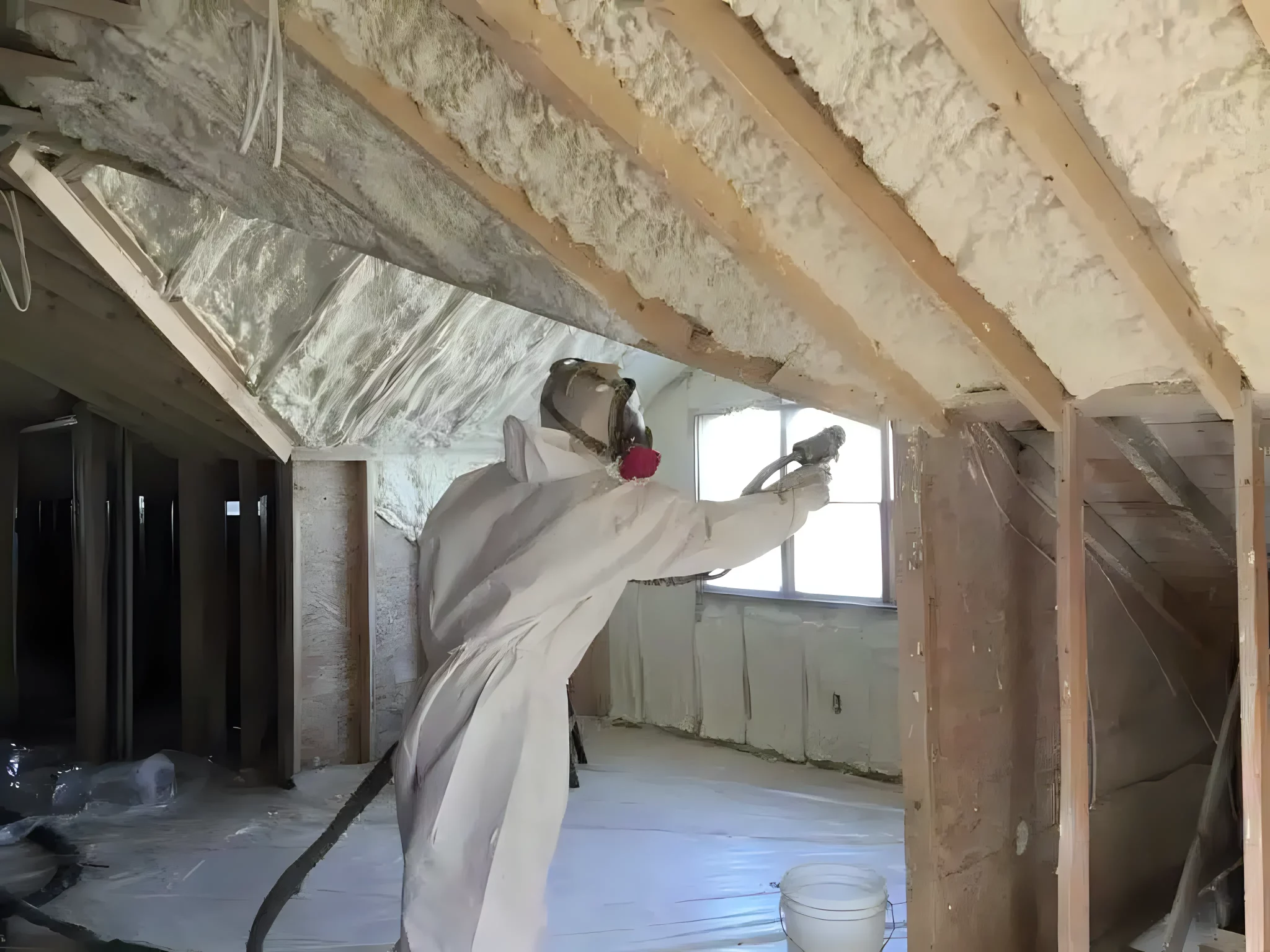
The installation method depends on the insulation type. Batts are cut to fit and friction-fit into cavities. Loose-fill materials are blown into open attic spaces or dense-packed into closed wall cavities through drilled holes. Spray foam is applied using specialized equipment that mixes two chemical components at the point of application. Rigid foam boards are cut to size, attached with mechanical fasteners or adhesive, and sealed at all seams.
Quality Control
Quality control is where many projects fall short. Common installation defects include compressed batts, gaps around obstacles, missing insulation in hard-to-reach areas, and improper air sealing around penetrations. These defects can reduce effective R-value by 30% or more, even when the specified insulation material was used. A quality insulation installer will use rulers to verify depth, infrared cameras to identify gaps, and visual inspections to ensure complete coverage.
Measuring Success: ROI and Performance Metrics
One of the most common questions we hear from building owners and facility managers is: “How long will it take for this insulation investment to pay for itself?” The answer depends on several factors, but the data is encouraging.
Payback Periods
Payback periods for commercial insulation vary by building type, climate, existing insulation levels, and energy costs. In commercial roof and pipe insulation retrofits, the ICF study found that energy savings from pipe insulation upgrades in industrial facilities can deliver payback in as little as six months to one year. Commercial building roof and pipe insulation upgrades typically deliver positive returns well within the service life of the insulation, which can exceed 30 years.
Energy Benchmarking
The best way to track insulation performance is through energy benchmarking. Many commercial buildings already use the EPA’s ENERGY STAR Portfolio Manager tool to track energy use intensity (EUI), measured in kBtu per square foot per year. By comparing your EUI before and after insulation upgrades, you get a clear, data-driven measure of improvement. ENERGY STAR certified buildings use 35% less energy than typical buildings nationwide.
Long-Term Value
Insulation is a one-time investment that delivers savings for the entire life of the building. Unlike mechanical equipment, which requires regular maintenance and eventual replacement, insulation performs silently for decades with no upkeep. It also contributes to higher property values, lower tenant turnover (due to improved comfort), and reduced capital costs for heating and cooling equipment, since better-insulated buildings can often use smaller HVAC systems.
Future Trends in Commercial Insulation
The commercial insulation industry is evolving rapidly, driven by three main forces: tightening energy codes, decarbonization goals, and advances in material science.
Stricter Energy Codes
Each update to the IECC and ASHRAE 90.1 raises minimum insulation requirements, particularly for continuous insulation on commercial walls and roofs. The trend is unmistakable: future commercial buildings will require significantly more insulation than buildings built even a decade ago. For building owners, this means that insulation upgrades are not just an opportunity for savings. They are increasingly a requirement for code compliance and lease agreements.
Building Decarbonization
With commercial buildings responsible for a substantial share of U.S. greenhouse gas emissions, insulation is being recognized as a front-line tool for decarbonization. Unlike many clean energy technologies that require years of development and deployment, insulation upgrades can be implemented immediately using existing materials and techniques. The EPA identifies building envelope improvements as a key strategy for reducing emissions from the commercial sector, alongside more efficient HVAC systems, LED lighting, and electrification.
Sustainable Materials and Manufacturing
Insulation manufacturers are investing in materials with lower embodied carbon, higher recycled content, and improved end-of-life recyclability. Fiberglass already contains 40 to 60% recycled glass, and mineral wool incorporates 10 to 75% recycled blast furnace slag depending on the type. Bio-based spray foam formulations using castor and soy oils are also entering the market, though their long-term performance data is still developing compared to traditional formulations.
High-Performance Building Certifications
Programs like LEED, Passive House, and the Living Building Challenge are driving demand for insulation systems that go well beyond minimum code requirements. Net-zero energy buildings, which produce as much energy as they consume, rely on super-insulated envelopes to minimize heating and cooling loads before adding renewable energy systems. This trend is pushing the commercial insulation industry toward higher R-value materials, continuous insulation systems, and more precise installation practices.
Putting Your Commercial Insulation Strategy into Action
The path to a well-insulated commercial building comes down to three steps. First, assess where your building stands today. An energy audit or building assessment will reveal exactly where insulation is missing, damaged, or inadequate. Second, prioritize the areas where insulation will deliver the greatest impact. Roof insulation and air sealing typically offer the best return in most commercial buildings. Third, hire experienced professionals who understand both insulation materials and building science, not just how to fill cavities with material.
The data makes the case clearly. Commercial insulation reduces energy consumption by measurable percentages, cuts greenhouse gas emissions by hundreds of millions of metric tons over the service life of the insulation, and pays for itself within years while continuing to deliver savings for decades. This guide is here as a reference you can return to as you plan, specify, and implement insulation upgrades across your buildings.
Need Expert Guidance?
If you are ready to assess your commercial building’s insulation needs or plan a retrofit project, our team at Cascadia Spray Foam is here to help. We bring years of experience working with commercial buildings of all types and sizes, and we can help you identify the most cost-effective improvements for your specific situation. Reach out to us at [email protected] or call (425) 386-3500 to schedule a consultation.
Frequently Asked Questions About Commercial Insulation
What is the best insulation for commercial buildings?
The best insulation depends on the specific application, climate zone, and performance priorities. Spray foam offers superior air sealing for irregular spaces. Mineral wool provides non-combustible fire protection and excellent sound control. Fiberglass delivers reliable thermal performance at a lower cost. Polyiso rigid board provides the highest R-value per inch for space-constrained commercial roof assemblies.
How much insulation does a commercial building need?
Minimum R-values are set by the IECC and ASHRAE 90.1 based on your climate zone and assembly type (walls, roof, foundation). Many building owners choose to exceed minimum requirements for improved performance and future-proofing. A building energy assessment can help determine the optimal insulation levels for your specific building.
Does commercial insulation also help with sound control?
Yes. Insulation materials like fiberglass and mineral wool significantly reduce sound transmission between spaces. Mineral wool is particularly effective, achieving STC ratings of 43 in standard wall assemblies and NRC ratings up to 1.00. This makes insulation essential for hotels, office buildings, schools, and healthcare facilities where noise control is a priority.
How long does commercial insulation last?
Properly installed insulation in commercial buildings lasts the entire life of the building. Fiberglass and mineral wool batts do not settle over time. Spray foam maintains its structure and R-value for decades. Rigid foam boards are durable and resistant to moisture and compression. Insulation is one of the longest-lasting building components you can invest in.
Can insulation be added to an existing commercial building?
Yes. Retrofit insulation is a growing segment of the commercial insulation market. Common methods include drill-and-fill for wall cavities, blown-in insulation for attics and roof assemblies, spray foam for hard-to-reach areas, and rigid foam added during roof replacements or re-cladding projects. Retrofitting insulation in existing buildings is one of the most cost-effective ways to improve energy performance.
Is spray foam insulation safe for commercial buildings?
When properly installed by trained professionals following manufacturer guidelines and building codes, spray foam insulation is safe. It must be covered with a thermal barrier like half-inch gypsum board. The installation area requires ventilation, and occupants typically need to vacate during and immediately after application. Spray foam contains isocyanates during installation, so proper safety protocols are essential.
Sources
Insulation Institute – Comprehensive comparison of commercial insulation types covering thermal performance, fire protection, moisture, sound control, and sustainability. Published by the North American Insulation Manufacturers Association.
ENERGY STAR – Facts and statistics on commercial building energy performance, including data on ENERGY STAR certified buildings using 35% less energy than typical buildings nationwide.
Insulation Outlook Magazine – Summary of the ICF International Insulation Industry Opportunity Study confirming energy and emissions savings from commercial building insulation retrofits.
U.S. Environmental Protection Agency – Official data on greenhouse gas emissions from the commercial and residential sector, including the 31% share of total U.S. emissions in 2022.
I’m Melissa Grant, owner of Cascadia Spray Foam Insulation, with over 10 years of hands-on spray foam experience. I focus on durable insulation solutions, improved comfort and energy efficiency, and excellent customer service.
Selecting the right commercial insulation for warehouses comes down to five considerations: thermal performance matched to your climate zone, air sealing, moisture and vapor control, code compliance, and installation quality.…
Residential insulation addresses heat transfer through attic assemblies by slowing all three ways heat moves: conduction through framing and drywall, convection through air leaks, and radiation from a hot roof…
Open-cell spray foam provides useful coverage across irregular areas wherever a cavity is too deep, too uneven, or too cluttered with framing, wiring, and pipes for batts or rigid boards…