
Cascadia Spray Foam is a spray foam insulation company Kent, WA homeowners, builders, and commercial property owners can call for insulation that seals air leaks and helps hold indoor temperatures steady. Kent's wet winters and its mix of houses, apartments, and warehouses make the building envelope worth getting right the first time. We install open-cell and closed-cell foam in attics, walls, foundations, and roofs. As a spray foam insulation company, we start with how your building is built and used, then recommend the foam type that fits. Call (425) 386-3500 to discuss your spray foam insulation project in Kent, WA.
Kent sits in the Kent Valley south of Seattle, where a marine climate brings mild but wet winters. NOAA's 1991–2020 climate normals for Kent show roughly 150 days a year with measurable rain, and King County is classed as Climate Zone 4C (Marine) in the Washington State Energy Code.
Long damp seasons mean heated indoor air keeps meeting cold roof sheathing, wall cavities, and crawl spaces, where moisture can condense if air leaks go unsealed. Kent's single-family homes, apartment buildings, and large Kent Valley warehouse roofs all lose heat through the envelope in different ways. Energy-efficient spray foam insulation addresses both problems by sealing leaks and adding R-value, as long as the foam type is matched to each assembly.


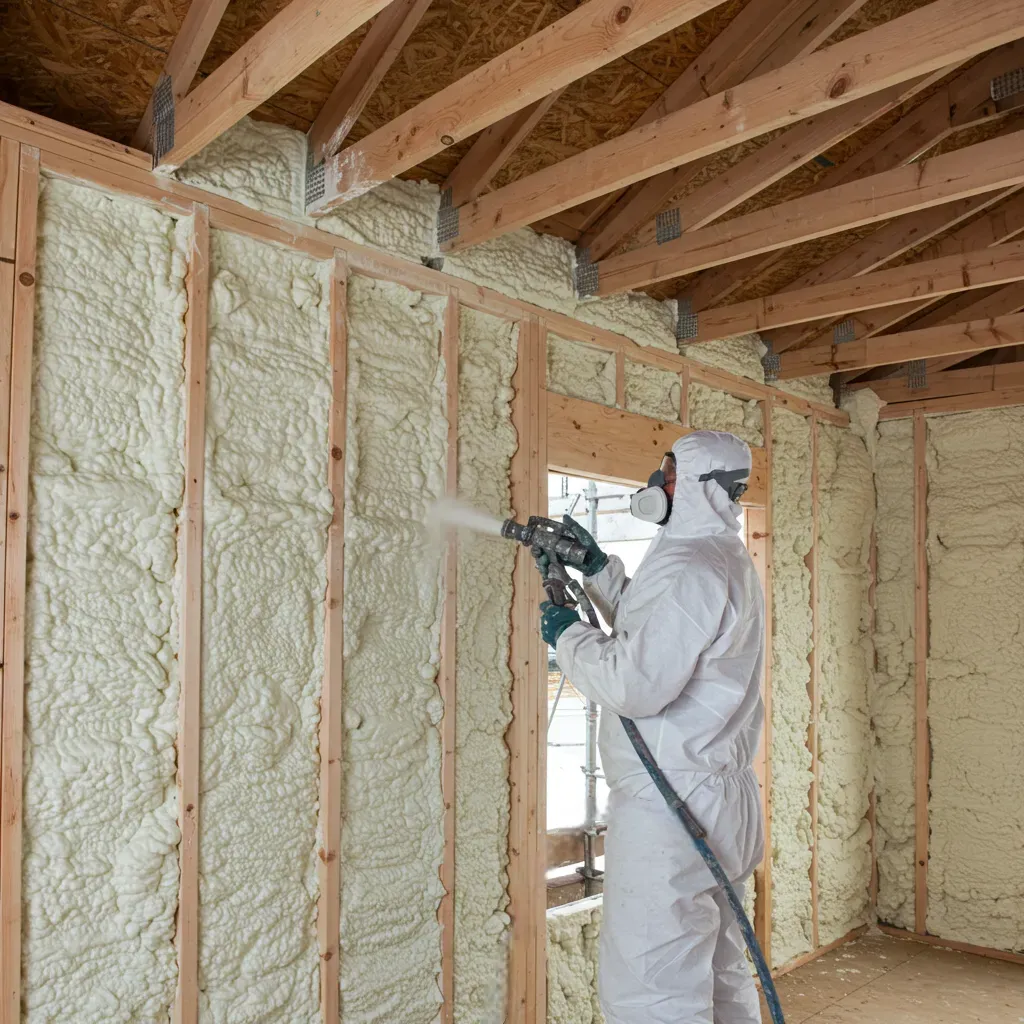


Call (425) 386-3500 to talk through the spray foam installation services Kent, WA property owners request for attics, walls, foundations, and roofs.
Call (425) 386-3500 and describe the property, the area to be insulated, and any problems such as drafts, cold rooms, or condensation.
Tell us about your property and the areas you want insulated, and we will recommend the foam type and approach that fits. Call (425) 386-3500 or email [email protected] to get started. We also work with property owners in Auburn, WA, Des Moines, WA, Covington, WA, Federal Way, WA, SeaTac, WA, Renton, WA, Maple Valley, WA, Burien, WA, Tukwila, WA, and Black Diamond, WA.
It depends on the product and how it cures. Follow the manufacturer's re-entry time, which your installer should give you before work starts.
It can if a roof leak or wet framing is covered over. Leaks should be fixed first, and the foam type should suit the assembly.
Generally no. The foam expands as it is applied, so existing walls usually need to be opened during a renovation first.
The area covered, foam type, thickness, access, and any surface prep. Closed-cell foam generally costs more than open-cell.
Building codes generally require a thermal or ignition barrier where the foam is in an attic or crawl space a person can enter. Some intumescent coatings qualify.


